Pearce's New Initiative: Listen First Project

@ListenFirstProj Tweets

Showing posts with label Economy. Show all posts

Saturday, July 9, 2011

On a Grand Bargain to Avert Debt Crisis

Note: It's been eight months since I last wrote on Election Eve. I had the engaging of Chrissy to take care of immediately after the election and have been rather busy since then. I look forward to writing more frequently as Election 2012 comes into focus. It's only 487 days away! In the meantime, follow my political thoughts on Twitter, @PearceGodwin.

Ongoing discussions taking place between the White House and both parties in Congress aimed at finding a solution to raise the debt limit, which America will breach on August 2nd, and returning to fiscal sanity by reducing out of control federal spending have taken an optimistic turn in recent days. As per usual, politicians only get serious and truly come to the table at the 11th hour with their feet to the fire. Reference the deal to avert government shutdown in April. This is true of any opposing parties involved in high stakes negotiation. With their backs to the wall, a compromise tends to result. We see this playing out again as the President reported Thursday that Democrats and Republicans are now coming to the table "in a spirit of compromise" and had "a very constructive meeting" realizing that "there is going to be pain involved politically on all sides." There is no bigger issue facing the U.S. today. If we don't solve this debt crisis and reign in our spending binge, we won't have an economy worth being employed in, never mind one that leads the rapidly evolving and globalizing world.

In light of these developments, I sent the following message in a series of tweets Thursday.

@PearceGodwin: Hoping for a grand compromise in order to take bold and decisive action to pull our country off the financial precipice of our national debt. As much as I favor slashing spending to raising taxes, afraid ruling out half of the balance sheet equation won't cut it. All remedies must be on the table to avert true economic crisis which could cripple America's financial stability and global stature.

Reaction from my conservative Republican friends was swift and provoked a great discussion on spending, taxes and debt. This is exactly the kind of honest and comprehensive discussion I hope is taking place on Capitol Hill and in the White House now. Read the discussion below and then weigh in. Offer your thoughts in the comments section or on Facebook and Twitter, where it has played out thus far. This is what collective problem solving is all about. In this case, the future of America depends on it.

Hill Republican:

Come on, bro. We can't be raising taxes during a recession! Federal budget increases of 20% or more for each of the past two years is simply not sustainable. Just go ahead and say it...you're supporting tax increases.

Larry Shoemaker:

I can tell you from the business side if you raise taxes on business or business owners, businesses will not increase hiring. Will likely decrease employment. Until businesses have some assurance about taxes and regulation, they are not going to expand-too much risk. Texas created more than half of all new jobs. Look at their taxes, tort reform, etc.

Pearce:

Hill, you know I would cut every last ineffective, inefficient and unnecessary government program before even thinking about tax increases. Drastically slashing spending must be priority #1. I just think trying to solve a problem this dire and of this magnitude will unfortunately require looking at both sides of the balance sheet rather than taking an unequivocal hard line to solve our debt problem with one hand tied behind our back. Any way you slice it, tax increases, first via efficiency reform and closing loopholes rather than rate increases, will get us to fiscal solvency faster when added to the X that is the amount cut. We must balance the need to turn the ship around fast with the deleterious effects we know any tax increase will have during a recession. We absolutely should not raise rates on job producers, including the "millionaires" who represent many small business job engines, at a time of such high unemployment. My point is that given the practical reality that we can work both sides of our red ink to reduce the debt faster, it is a conversation worth having.

Pearce:

Larry, agreed, can't punish the job creators, must find any new revenue elsewhere. Excellent example of a conservative vision promoting real growth and job creation. Obama should notice that fact.

Hill:

You can't balance the budget over night, but meaningful, incremental progress will avert a disaster. Can you tell me what is or how you define "tax loophole"?

Pearce:

When I say tax loophole, I'm not taking the negative connotation of an unintended escape hatch. I'm talking about exemptions, deductions and subsidies, some hardened on the books due to robust lobbying and archaic logic. We should take a fresh look at these and only give such breaks when it advances our economic and national interest. They are an important incentivizing and market shaping tool but should be wielded carefully under such a debt crunch. Eliminating some of these out of date or unwise tax breaks would increase our revenue without raising rates at all, especially in sensitive areas critical to recovery, which of course in and of itself will increase tax revenues.

The GOP was right to anchor our negotiating position at the hard line of no tax increases, period. I understand tactical negotiation. However, we all know that neither side is going to lay down and die. Dems have the Senate and White House so must get enough out of the deal to win over Obama and four Democratic senators (or three plus Biden), unless of course we're talking about a supermajority to break filibuster. Therefore, changes to the tax code can't be dismissed out of hand as part of an honest and comprehensive discussion of the issue. If the President is genuine in pushing his caucus to go big in putting entitlements, the biggest components of this crisis which cannot remain untouchable if we are to solve it, on the table, it is fair for us to consider the appropriate level of taxation and subsidy as well. Whatever it is now, isn't perfect, so we should seek to make improvements that will expedite budget balance, promote recovery and strengthen overall economic health.

Hill:

While I appreciate the fresh, centrist tone you posit, I'm afraid the policies you're advocating will have a similar effect on the economy as raising taxes during a recession--which you defacto support. Unfortunately the unemployment rate ticked back up to 9.2% today, a rate that should have been, at the very least, sub-8.5% by now according to our Vice President. That said, the word "subsidy" is just another way of saying "tax credit" as you note and millions of businesses and individuals, both parents that send their kids to college and homeowners that write off their home mortgage interest use these "loopholes" as you refer to them, which incent certain economic activities our government has historically said it supports. Sure we should take a look at them when our economy is back on track, as we should do for every regulation on the book to ensure we don't impede job growth and business activity, but make no mistake about it, eliminating most of these "loopholes" will translate into higher costs for consumers as you learned in Econ 101. If the Dems pass cap-and-trade, then you can expect your electric company to pass the additional costs along to you the consumer in the form of higher electricity rates. The same holds true for most other federal cost-raising activities. I am not certain our economy can handle a fresh impetus for rising consumer prices, especially considering inflationary pressure from the record spending sprees of the past is really starting to take hold and will suppress consumer spending and thus broader economic growth. Let's just be carefule for we aren't out of the woods yet. We can and must pay down the debt without raisng taxes on job producers and consumers.

Chris Mike:

Compromise = lose.

Pearce:

Chris, I disagree that compromise = lose. The Constitution set up a system of government that, because the American people prefer and vote for split government between Democrats and Republicans, requires compromise to pass legislation. There are certainly core principles which should never be compromised, but there is often a vast playing field between the two sides' core endzone positions ripe for bargaining towards a mutually agreeable-enough-to-pass solution. I prefer to think compromise = progress. A stagnant, paralyzed federal government incapable of promoting national interest (i.e. something akin to what we have now) = losing.

Hill:

Yeah, but remember that Republicans only control one chamber of Congress and not the White House. It's not exactly a level playing field, yet at least.

Pearce:

Hill, sounds like our only point of disagreement is the timing of said fresh look at tax credits. Many such credits are prudent and wonderful tools which encourage the invisible hand of incentives among "selfish actors" in the economy, promoting positive choices such as college, home ownership and business expansion. That said, I'm quite sure there are some which are out of date or otherwise unnecessary that are keeping dollars out of our federal account which could be used to pay down our debt and reduce dependency on foreign nations.

Unfortunately, it seems Washington only acts when our feet are to the fire. Right now, our feet are to the fire on the debt limit. Therefore, I see this as a perfect time to pursue every opportunity for correcting and improving the financial mess we've created, including in the bloated tax code. We should not leave any stone unturned at this rare moment of receptivity to bold action on both sides of the aisle.

Any direct or indirect increase in taxes will indeed have an adverse impact on the affected consumers thus depressing economic growth to some degree. That is a cost to reform, a particularly high one in a time of recession toward fragile recovery, but it must be weighed against the long term benefit of tax reform at a moment of possibility to take such action which we may not see again for a very long time.

Hill:

There's little we can do to ensure these spending cuts are adhered to in the future, given annual consideration of appropriations bills. Once the President gets his tax increases, those are much harder to roll back. Any way you want to message it you're advocating for using this "perfect time" to raise federal revenue on the backs of businesses, consumers and other "selfish actors" as you call them during a recession. I know your message has probably polled well in a Facebook focus group, but be careful about who your audience is. We can eliminate our debt without increasing costs to consumers.

Pearce:

Important point on the permanency of the remedies proposed and potentially accepted by each side. Constitutional amendments to balance the budget have been discussed but, as you know, would only become an excuse for raising taxes rather than cutting spending down the road. We cannot raise any tax, including the elimination of credits, with any hope or expectation that the move will be reversed in the future. Therefore, such moves should only be supported if we believe they are good permanent fiscal policy. We cannot fall for the ruse of a temporary tax increase to address the deficit. Not only is this the worst possible time as we "tread water at the bottom of a very deep hole," but, as you point out, there is no more a temporary tax increase than there is a temporary spending increase. That's how we got into this mess. Taxing and spending gone mad over the last decades. And yes, Republicans are rightly blamed for part of this plague, however nothing in comparison to the way in which Obama has floored it towards the cliff.

To be clear, I am not advocating for raising federal revenue. I am advocating for allowing the idea to be part of a comprehensive and exhaustive conversation to avert a debt crisis and promote growth. The reality is that their are two numbers which combine to determine our debt, revenue and spending. There is no doubt about what must be done with spending, and it must be drastic and it should hurt. Any serious discussion will also include the issue of revenue; this is that discussion. There are innumerable problems with raising revenue, especially now, that anyone with an understanding of Econ 101 should get. Therefore, it's entirely possible that after considering the revenue side of the equation, we would rightly determine that it should not be increased in any way, in order to promote rather than depress growth. My objection is to a dismissal out of hand of even considering revenue. That is irresponsible and dishonest. Thoughtful individuals on both sides consider all elements and then draw firm conclusions, not the other way around. You, of course, have a full understanding of both revenue and spending in all of its many forms and implications, but I'm concerned that some are more interested in rhetoric and partisan pride than fully assessing and solving this problem.

Chris:

The real compromise would be to pass some deep spending cuts before we even start discussing anything else. After all, the Republicans did just win a historic election eight months ago. Let's see the conservatives in action! And by the way, you're forgetting Art Laffer and the fact that tax cuts will boost the economy and raise fed government revenue anyway.

Pearce:

I love Laffer. His curve is genius yet so logical. Under the premise that we are at a state of general over-taxation, you're right, leaving more money in people's pockets will increase spending and thus tax revenues. That's why the Christmas deal to extend the Bush tax cuts was positive. Conversely, raising taxes beyond the optimal point will actually depress revenues as Americans stop spending and producing to generate the wealth that is taxed. Not forgetting him. Laffer's concept should be a major component of this comprehensive discussion.

Monday, December 14, 2009

2009 Roundup: Health Care, Afghanistan & The Economy

UPDATE 12/24/2009: The United States Senate has passed its version of the Democrats' health care bill on a 60-39, strict party-line vote which took place Christmas Eve morning. Democratic leaders in the House and Senate will now work to merge the Senate bill with the much more liberal House bill. Senators Lieberman (I-CT) and Nelson (D-NE) have vowed to veto the final bill if it moves left of the version they supported this morning. With their more moderate interest on one side and disenchanted House liberals on the other, the Conferencing of the two bills promises more drama, deal-making and a still uncertain fate for President Obama's top legislative priority.

ORIGINAL POST: As the pre-teens draw to a close, let's look at the big issues dominating our collective consciousness and political discourse, issues that set the stage for the 2nd decade of the 21st Century and will determine the course of politics and the balance of power for years to come. 2009 began with a monumental event in history as America saw the first black citizen assume the office of the presidency. Most Americans met this milestone with enormous hope, hope that far out-sized any one man's ability, even the most powerful man in the world. Hope has turned to frustration as President Obama has struggled to unite political factions, quickly repair the economy or pass his landmark legislation, health care reform, to this point. The President has three years to recover; Democrats on the Hill have 10 months. Both have seen their fortunes turn rather dramatically since sweeping wins in November of 2008.

Democrats' health care reform legislation remains bogged down in flying sausage, though an end is potentially within site as Democrats desperately fight to give Obama a landmark 1st-year achievement and pass a bill before Christmas. I've written 8 posts on health care with a good bit of background and plenty of my views on the issue. In sum, health care reform is of critical importance to the longterm sustainability and decency of the country we all love, BUT, unlike Americans, all health care reform is not created equal and is not by definition a positive step forward for the nation. Health care reform which fails to address the fundamental issues underlying our health care crisis of costs, quality & coverage and only adds more people, programs and taxpayer dollars to a quickly failing system will only exacerbate the problem and send us faster into the abyss. This type of legislation is indeed far worse than doing nothing. This is not to say that all Democrat ideas embodied in their bills fit this profile, but those which do are a grave concern. Indeed there is room for hope that with some of the pilot projects in the Senate bill aimed at controlling costs, current legislation will be a first step in a long process of getting the system under control. Forgive me for being skeptical and believing Democrats have put the cart before the horse, expanding coverage with very little real effort to first control exploding costs. With all of that said, let's see where we are with 17 days remaining in 2009.

For months now, public opinion has been trending against Democrats' health care reform, with no momentum following passage in the House. The latest CNN poll shows 61% in opposition to the bill. Also, a majority disapprove of the President's handling of the issue. Americans' believe health care coverage is not the government's responsibility and that their costs will increase. They think it is the wrong time for health care reform in light of the economy, unemployment and the growing deficit, which most believe these bills will increase. Perhaps surprisingly, much opposition is from the left.

This has made health care reform an excruciatingly tenuous issue for Democrats facing voters in only 10 months. The fact that they are sitting on a very different political timeline than that of President Obama is causing much concern. These lawmakers are trying to figure out how a vote for health reform against the will of voters will be anything less than a death sentence for their political careers. Despite being the Senate Majority Leader, Harry Reid is in
more political trouble over health care than most members of his caucus as his state stands firmly against his bill. One idea is to push benefits up to 2010 in order to show tangible, positive results before voters head to the polls. Stu Rothenberg wonders Democrats are trying to walk off a cliff as those most likely to vote in 2010 are against the Democrats' reform.

The bills passed by the House and the one currently at play in the Senate are being decried by smart observers and activists on the right and left. The left complains that the bills do not contain a "robust" public option, aka quick trojan horse to single payer care, that they still leave millions uninsured and that the House bill restricts government subsidies of abortions. The right is incensed by the expansion of government control over patients' decisions and treatments, the fact that the bills bend the cost curve up instead of down as confirmed by the director of the Congressional Budget Office and the CMMS, the increase in individual insurance premiums, that they fail to block illegal immigrants from receiving coverage, that millions will lose their coverage, that they include potentially unconstitutional individual mandates, and that the Senate bill slashes Medicare, an arguably hypocritical stance. Some Democrats and liberals are also raising alarms over the costs of the bills and demanding the ban on taxpayer funds for abortion. These bills indeed send several of the President's promises down the river.

The dean of Harvard Medical School penned a must-read piece in the WSJ saying he gives the current bills a failing grade. In Dean Flier's words,

Our health-care system suffers from problems of cost, access and quality, and needs major reform. Tax policy drives employment-based insurance; this begets overinsurance and drives costs upward while creating inequities for the unemployed and self-employed. A regulatory morass limits innovation. And deep flaws in Medicare and Medicaid drive spending without optimizing care...

The various bills do deal with access by expanding Medicaid and mandating subsidized insurance at substantial cost—and thus addresses an important social goal. However, there are no provisions to substantively control the growth of costs or raise the quality of care. So the overall effort will fail to qualify as reform...

In discussions with dozens of health-care leaders and economists, I find near unanimity of opinion that, whatever its shape, the final legislation that will emerge from Congress will markedly accelerate national health-care spending rather than restrain it. Likewise, nearly all agree that the legislation would do little or nothing to improve quality or change health-care's dysfunctional delivery system...

In effect, while the legislation would enhance access to insurance, the trade-off would be an accelerated crisis of health-care costs and perpetuation of the current dysfunctional system—now with many more participants. This will make an eventual solution even more difficult. Ultimately, our capacity to innovate and develop new therapies would suffer most of all.

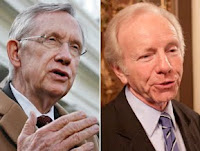
As Harry Reid frantically tries to round of the 60 votes needed to pass his health care bill, even inserting $100 million dollars for Louisiana to get Landrieu's support, Joe Lieberman has become the biggest thorn in his side. Lieberman was one of the Democratic Senators (yes, I know he's technically an Independent following his 2006 loss in the Connecticut Democratic primary, but he caucuses with Democrats) to demand scrapping the public option from Reid's bill. They succeeded. Yesterday, Lieberman announced that he would vote against the current bill, due to its expansion of Medicare (a "compromise" many, including the Washington Post, believe is a faster route to single-payer than the public option). Democrat Ben Nelson is also against the compromise. With only 60 votes in his caucus, including Lieberman, and no Republicans likely to support the bill, Reid has zero room for error. Politico is reporting that Obama has told Reid to give Lieberman what he wants (a report the White House denies), but Reid is holding on as the Senate is in hurry up and wait mode for the CBO score of the latest compromise deal due in the next day or two. Meanwhile, in the House, Speaker Pelosi proclaims she is ready to do "almost anything" to pass reform this year, setting up a potential showdown with her liberal wing who won't like the watered down Senate version. Needless to say, these disputes among Democrats pose a grave threat to the self-imposed imperative of passing reform in 2009. Obama has summoned the entire Senate Democratic caucus to the White House tomorrow for a meeting at this "make-or-break" moment for his health care overhaul.

In the end, as David Brooks says, health care reform rests on a values question, our values individually and as a nation. Their is no clear right answer. It is a "brutal choice." No one in this debate is evil or selfish. With all of our similarities as fellow citizens we have different values. That is as it should be, and those values inform our stance on health care reform. As Brooks explains the dichotomy,

Reform would make us a more decent society, but also a less vibrant one. It would ease the anxiety of millions at the cost of future growth. It would heal a wound in the social fabric while piling another expensive and untouchable promise on top of the many such promises we’ve already made. America would be a less youthful, ragged and unforgiving nation, and a more middle-aged, civilized and sedate one...

We all have to decide what we want at this moment in history, vitality or security. We can debate this or that provision, but where we come down will depend on that moral preference. Don’t get stupefied by technical details. This debate is about values.


The other major story as we conclude 2009 is President Obama's bold decision to send 30,000 more American troops into combat in Afghanistan. Obama rightly sees Afghanistan as imperative for our security. As he put it in March, “This will not be quick, nor easy. But we must never forget: This is not a war of choice. This is a war of necessity. ... This is fundamental to the defense of our people.” Everything is easier said than done. At West Point, the President turned those strong words into strong action, much to the relief and pleasure of conservatives, who feared weakness, and to the dismay of many liberals. Indeed, on Afghanistan, the President is dealing with reverse coalitions. The political peril in the President's decision makes it all the more admirable.

The President has tried his much discussed soft, outstretched hand approach and against challenges, reality and limited success, has been forced to move on to plan B. His decision process on Afghanistan was long, laborious and, to some, amounted to dithering. It was clouded with leaks and angry conflict between the White House and its own commanders. However, he did come to a firm decision and is moving forward. This President operates in "analytic mode," dispassionate but serious and thoughtful.

In the next sentence after announcing the troop buildup, the President stated that troops would begin withdrawing in July of 2011, an obvious concession to his base. His advisors differ on how firm that date is, but we know now this President is serious about and taking ownership of this war. I, therefore, have little concern that he will cut and run in July of 2011. He said nothing about how steep said draw-down would be.

In Oslo last week, President Obama accepted the Nobel Peace Prize. He used the opportunity to give a poignant defense of war. This was no doubt jarring to his immediate audience but encouraging to conservatives at home who have worried this man is too naive and idealistic to lead in our world in which, as he stated, "evil does exist." We learn a lot about Obama the man through his speeches and some see the most recent as a move to the center, a place of strength for an American president, and a foreign policy shift as Obama bows to reality.

The stark reality is that terrorists dreaming of and plotting for the destruction of America are still not tired. We must fight on, steadfast in our commitment to freedom and security. To prevail we must have strong allies, a major question mark in Afghanistan. I hope and pray Obama's decision was right. I hope he found the perfect balance between our national security, his most solemn duty, and the risk to our brave men and women, our most precious treasures. Obama can win in Afghanistan, and if he remains firm in his resolve, conservatives and Americans at large will stand behind him through thick and thin, all the way to victory.

The economy, the one issue in politics that voters think about every single day, every time they pull out their wallets and every time they think about the future. The economy is the top issue for voters now as it has been for most of 2009. With unemployment rising to 10.2 percent in October and the '09 deficit topping $1.4 trillion, Americans are understandably worried and skiddish. The U-6 statistic tells us that a more accurate look at total economic dislocation is 17%, which includes underemployment. For Democrats, that means it's time to put jobs first or risk enraging the struggling electorate. With every passing day, the "rubble" of the economy is increasingly at Obama's feet, and Americans expect him to fix it. Interestingly, Democrats are more likely to be unemployed than Republicans. Blacks are worst hit, with 35 percent of the young unemployed.

While there are green shoots in the economy, recovery is scarcely touching jobs. The White House is doing its best to convince voters that the stimulus package has "created or saved" thousands of jobs, but watchdogs have concluded those advertised numbers are inflated, inaccurate, temporary or just made up. Now, finally, the White House seems to be turning its attention to the deficit, hopefully in earnest. The wave of debt payments facing the government have the potential of crippling the economy, again. Voters rightly see deficit reduction as the top budget priority for Washington, well above health care. At the same time, voters worry the government will do too much for the economy, making the situation worse and hampering recovery. Only 23% of Americans trust the federal government to do what is right. 76% prefer a free market economy, and Republicans are now trusted more than Democrats to fix the economy. Mitt Romney, an almost certain presidential candidate in 2012, has outlined his plan.

Americans need economic recovery. We need a renewal of "moral materialism" and the manic energy which has taken America from the banks of Plymoth to the pinnacle of prosperity, power and influence. We've survived the shocks of a year ago, but people are truly struggling and having a hard time seeing the light at the end of the tunnel. We must unleash market power and individual innovation to ensure a bottom up recovery for America, quick, strong and enduring.

2009 LEFTOVERS


As you enjoy the many college football bowl games this holiday season, think about whether or not the government should intervene to push for a playoff to replace the BCS system. Principled conservatives believe this idea, by a Texas Republican, should "draw a 15-yard penalty for unnecessary roughness to the idea of limited government."

On Tiger, how utterly disappointing. Read Bill Simmons' piece on the "zoo."

As far as views on Christmas across the country, 76% believe religious symbols should be allowed on public land, 72% prefer "Merry Christmas" to 'Happy Holidays" and 77% say they've been nice this year. I'm with the majorities!

As we move into decade 2 of the 21st century, we're witnessing the end of the email era as Twitter is changing the way we live.

Consider giving cash or gift cards this year. It's better for the economy.

Finally, I'm very proud of Raleigh-Durham, NC for being ranked the smartest city in America! Let's Go Duke! And Carolina is pretty smart too.

Have a Merry Christmas & Happy New Year!!
Seeya in 2010! Midterm elections anyone?!

Tuesday, September 22, 2009

Additional Challenges: The Economy & Afghanistan

With the fierce debate over health care reform dominating the headlines and Washington dialog, it is easy to forget that there are several other issues at least as, if not more, important demanding the attention of the President, Congress and engaged Americans. The first is our still fragile but likely recovering economy, indeed rated as the most important issue by voters, twice as important as health care. You wouldn't know it by looking at unemployment numbers, as this has been and will be for quite a while a jobless recovery, but other indicators give reason for optimism that we have indeed come back from the brink and that the recession is over. Just how close we were to the proverbial brink is only known by the wonks who spend sleepless nights a year ago this month working to prevent an historic, and global, total collapse, but from what I've heard, the American people are better off not knowing how close we were to economic catastrophe. Even with the economy stabilizing, worries linger and people are understandably skiddish, planning to refrain from boosting their spending, a much needed catalyst to recovery.

We have seen the federal government take drastic, and in some cases unprecedented, steps to rescue major sectors of the economy: from bank bailouts begun under W to taking ownership of GM and passing a $787,000,000,000 "stimulus" package which a majority of people don't believe is working and some see as an utter failure. One study warns that Obama is making "Great Depression" policy mistakes. Americans, who by and large still believe in limited government, have begun to balk at these interventions, fear the government will do too much to fix the economy and oppose new regulation of the financial system. Many also see some of the policies coming out of the White House as job killers that could doom Democrats. The intensity of opposition is working against the President as 65% believe he has taken on more than he should have.

The August jobs report showed the unemployment rate increasing to 9.7% on its way to double digits according to most analysts, including the White House, which promised no higher than 8% if the stimulus passed. Based on the President's pledges on job creation, he is now running a 5 million job deficit; will he be held accountable for his rosy claims? Conservatives criticize Obama's policies as a major reason job creation is not happening. With 79% knowing someone out of work, the dire unemployment situation is personal. In addition, while most Americans believe tax hikes hurt the economy and favor tax cuts over more government spending, more than two-thirds believe Obama will break his campaign promise and raise their income taxes in his first term.

President Obama's actions on the economy have drawn criticism from across the oceans as well. He has increased tariffs and non-tariff barriers to trade, leading the Wall Street Journal to call him a protectionist president and charge that he is abdicating U.S. trade leadership. I am a big believer in the universal value and net benefit of free trade, so this is very troubling. Warren Buffett explains the consequences of the astronomical deficits we are now running, financed by our friends overseas, which are set to "soar" with Obama's new programs to $1,500,000,000,000 in 2010. Obama is set to triple the national debt to $14,200,000,000,000 by 2019. This is creating doubts about the longterm viability of the dollar among investors and the international community, with the UN calling for a new global currency. The United States has lost it's top spot as the world's most competitive economy for the first time as a result of the crisis, placing 2nd to Switzerland.

The President continues to lay blame for the economy at the feet of Bush, although more view his presidency as a failure than did Bush's after 6 months in office, but Americans will only buy the blame shift for so long. More now disapprove of the President's handling of the economy than approve, and his numbers continue to fall including a 19 point drop since January in his leadership rating. Some speculate that piling up debt, gaffes and hypocrisy are sinking Obama and that, thus far, he has "failed miserably." Eventually this will be his economy alone, and he will have to answer for it. If that time comes before the 2010 midterm elections and unemployment is still hovering around 10%, something no one is hoping for, it could spell major electoral trouble for Democrats. After all, "it's the economy stupid."

Earlier this month, we remembered the day that will forever mark my generation, the day our grandchildren will ask us about. Our grandparents lived the horror of Pearl Harbor; our parents learned from their teachers that their President had been assassinated; we watched on our school TVs as America came under attack and the twin towers crumbled. No, we will never forget where we were that day or the feeling of shock we felt as our bubble of security was violently burst by evil terrorist with no regard for innocent human life. However, 8 years after that tragic day, the War it provoked is facing new challenges and losing public support as 49% believe the impact of 9/11 has been forgotten by most.

Commanding General McChrystal has told Obama he will need more troops or else the war "will likely result in failure." The President, under pressure from lawmakers on Capitol Hill has said he will not rush his decision and is demanding a clear strategy before sending any more Americans into combat. The Pentagon has delayed its call for additional forces pending a review of the strategy. July and August were the deadliest months for our troops in the conflict. Obama is facing waning support across the nation, with 20% saying we should pull out immediately, and major doubts among his Democratic friends on the Hill. Among conservatives, some believe it is time to get out, while others see no choice but to try. All agree that the War presents President Obama with a major test of his leadership as the AP reports he may change course again.

Security issues threaten to steal the spotlight that has been on health care for the last several months as Obama cannot avoid the great challenges and hard choices which face him. The world's atomic watchdog believes Iran has the ability to make a nuclear bomb as the U.S. says the rogue nation could expedite the process. Meanwhile, President Obama has scrapped plans to deploy a ballistic-missile defense shield in Central Europe. This very controversial move, domestically and abroad, is based in a "gamble that scaling back defense ambitions will improve security in the long run." Members of both political parties in Congress have expressed concern over the decision as Heritage calls the move a "shameful surrender." As for the American people, 31% agree with the President while 38% disagree. Voters still trust Republicans more than Democrats to keep the country safe.

For a fresh look at the dynamics of international affairs, I highly recommend this fascinating piece in Foreign Policy magazine in which Marc Lynch illuminates the American primacy debate with an analogy to a feud in the hip-hop world involving Jay-Z.

For your laughing pleasure, definitely check out Sh&% My Dad Says and People of WalMart. I think every other picture was taken in North Carolina, Raise Up! Also, this dog really doesn't want a treat from Obama, and a space butterfly!

Make your opinion known in the PG Polls: Do you think the economy will hurt Obama and Democrats in future elections? Should we remain committed to the Afghan War, even sending additional troops, or abandon the effort?

The PG Blog has gained over 60 new fans in the past week. You can be the 300th! Thanks for the support!

Wednesday, September 2, 2009

The August Slide: Health Care & Obama

August has been a great month for Democracy, an active, passionate and vocal democracy, very American and created by a perfect storm that has resulted in the President suffering a precipitous fall in public opinion and his signature policy initiative going on life support in one of the "most rapid turnabouts in recent American political history." All Presidents fall at the end of their honeymoon, but no president has ever fallen this far this fast. The "August Slide," as David Brooks calls it, is not personal. Pollster Glen Bolger observes that the major hit Obama has taken in the past month is a function of a populace that still likes the President as an inspiration figure and positive image on the foreign state but is growing very skeptical and quite wary of his big government policies, as well as his leadership, down 19 points from January. The health care debate "is at the fault line" of a larger debate about the role of government. The damaging path of the debate caught Obama by surprise, and Charlie Cook believes the situation has "slipped completely out of control" for the President and Democrats.

Americans are waking up to the doublespeak the President and his Capitol Hill allies, to whom he has outsourced an inordinate amount of his policy formulation, continue to employ in frantically pushing their version of health care reform; Time calls these obvious paradoxes the fatal flaw of ObamaCare. The WSJ also describes the President's many contradictions, pointing out that voters aren't stupid and it's because they are listening that ObamaCare is in trouble. As the White House likes to say, "facts are stubborn things." Notice we haven't heard much from Obama lately about his unequivocal promise that "if you like your insurance, if you like your doctor, you can keep them." Why? It turns out saying something over and over with increasing force and conviction does not make it true. The Lewin Group, in a major analysis of the bill, estimates that 83 million people would be forced onto the "public option" under Obama's plan, losing their current, private coverage. Truly, no study was necessary to see the fallacy in Obama's claim. His purpose is sweeping health care reform that would transform the entire system... yet no individual would need to change their coverage. It's difficult to enact fundamental change if none of the players in the system change their behavior. Many Americans saw the wool being pulled over their eyes and reacted indignantly.

Speaking of wool being pulled over our eyes. Can we put to bed the debate about whether or not ObamaCare with a public option, not only would, but is designed to lead to single-payer care? Over the course of the debate, Democrat after Democrat, including Obama, has been caught telling friendly crowds that that is indeed the whole idea. The public option, it turns out, was part of a grand strategy developed in 2007 as a "stealth single payer." Hillary Clinton's chief strategist says the public option "was always meant as a transition to single payer, not merely as an aid to competition with private insurers." Case closed.

Obama would prefer single-payer, so why use the public option to get to the liberals' dream? Krugman explains that "politically it's hard to do in one step." I wonder why... Perhaps because only 32% of Americans favor single-payer health care. The rest understand what it would mean. Liberal leaders are being forced to confront a centrist nation. Realizing they've been found out, and with a plurality now opposing the trojan horse, the public option looks increasingly less likely to be included in any reform that passes. Meanwhile, Pelosi says she can't pass a bill in the House without it. In case you've forgotten why conservatives oppose the public option, here's Heritage...

The bottom line is that a public plan will grant the federal government unprecedented power to constantly tinker with the health care sector in ways that will make one sixth of our entire economy completely dependent on decisions made in Washington, DC. This is not the way free societies operate.

Democrats would also like us to believe their sweeping reform would be deficit neutral as Obama has demanded. It was a rude awakening for them when the nonpartisan Congressional Budget Office scored their bills between $1 and $2 trillion dollars. Director Elmendorf said that rather than "bend the curve" on health care cost as Obama has promised, his proposals would "significantly expand the federal responsibility for health care cost." We are then to believe that health care and all of Obama's other big government initiatives can be paid for by pillaging the wealthiest Americans with a variety of surtaxes. The Washington Post has called this a "mirage." As Margaret Thatcher said of Socialism, "the problem... is that eventually you run out of other people's money."

Obama is right to preach the dangers of inaction on health care. Health care spending, especially in the form of entitlements, is on an unsustainable and dangerous path, one that could bring down the entire economy. However, the President loses me in using this fact as rationale for passing legislation that we now know would only make our bleak budget outlook much worse. CBO director Elmendorf told congress that ObamaCare would "put an additional long-term burden on top of an already unsustainable path." Indeed, doing nothing would be better than accelerating our dive into the red; 54% of Americans agree.

Time Magazine laid out the challenge for Obama very well:

The hard part is making sure that in transforming a system that is bankrupting the country, Washington doesn't create a new one that does it even faster. Or that in expanding health coverage to the minority of Americans who don't have it, Washington doesn't leave the majority who do have it — and who like what they have — with less.

Unfortunately, the President's proposals fail on both counts.

Obama and Democrats in Congress have simply lost credibility with the American people, including their strongest supporters. Republicans are not trusted much more, but have overtaken Democrats on the question for the first time in years. Only 27% of Americans believe members of Congress have a good understanding of the health care issue as they look to reshape one-sixth of the American economy; voters think they know the bill better. The polls were turning against the President in the early summer and by the end of July, only 36% thought ObamaCare was a good idea. Gallop presented the top 10 takeaways of public opinion on health care at the time and the numbers all look bad for the President. Obama's power has been dwindling ever since, leading some to conclude that he does not know how to legislate. In August, voters came to appreciate more of the reasons the plan is bad for America. At this point, Obama has been dealt a major blow in the polls with his approval dropping to 46% in one poll and losing 17 points with Independents.

The last hope for a bipartisan bill rests with six Senators on the Finance Committee, but talks appear to be breaking down on irreconcilable differences. Desperate to pass their signature piece of legislation, regardless of what the American people think, Democratic leaders on the Hill are considering twisting Senate rules to force through a bill with no Republican support, a move that many commentators believe would be ultimately suicidal. Mr. Obama's pledge to be a post-partisan president has quickly fizzled as he wages a permanent campaign, employing the politics of fear and blame, instead of governing. He is also providing a variant, incoherent message, the result of allowing focus groups to dictate his language. The carefully crafted phrases that Obama has used repeatedly have thus far not convinced a skeptical public. He now faces a "politically explosive mix of unpopular policies and an angered electorate." Some believe Obama's smartest move would be to "pull the plug on ObamaCare" and find an exit strategy in order to save his presidency, but I'm not holding my breath. He is indeed pushing ahead with a new strategy and plans to address a joint session of Congress next Wednesday night in an attempt to regain control of the debate.

Clearly a lot has transpired in Washington and around the country in the last month in the tumultuous world of health care reform. There is more to discuss, but it can wait until next week as I anticipate being able to post more regularly. We'll address the question of health care as a right and the co-ops alternative, look at the absurd reaction from the left to this great piece in the WSJ by the CEO of Whole Foods as well as cover the economy, the GOP and other issues that have been muffled by the town hall volume of health care in August.

In the meantime, cast your vote in the latest PG Polls: Do you think President Obama will sign a major health care reform bill this year? Will Obama ever fully recover from his downward slide?

Wednesday, June 24, 2009

Iran's Clenched Fist, Obama's Sliding Polls, Health Care Sticker Shock & More

The declaration that Mahmoud Ahmadinejad was reelected as Iran's president has led to an unexpected uprising that has brought to light the fragile ground on which Ahmadinejad's repressive regime stands. The protesters believe, and the evidence indicates, that the election was rigged in favor of the incumbent regime which has responded with the iron fist of violence and attempts to extinguish what it sees as dangerous demonstrations of freedom.

President Obama has been exceedingly reluctant to speak out strongly against the violence of the government against peaceful demonstrators and offer support for the people hungry for true freedom and democracy. Some caution is understandable as he is in a "no-win situation." As Reuters explains, "strong criticism could backfire but a muted response leaves an impression of weakness." His response indeed looked weak to many, leading Obama to shift his stance and strengthen his language in recent days "condemning" unjust actions and saying he is "appalled and outraged" by the violence. It has also been pointed out that this presents the President with a dilemma within his own liberalism. No one knows how the crisis in Iran will resolve, but here are four potential outcomes.

This is all happening against the backdrop of Iran and North Korea continuing to pursue nuclear weapons that would be a grave threat to the US, its allies and the world at large. This has weighed heavily on the President's response. Both rogue nations, along with other Mideast setbacks, seem to have intruded on Obama's diplomatic hopes although Secretary of State Clinton insists that, even in light of the "appalling" human rights violations we have seen in the last week, the administration will continue pursuing talks with the regime. Some on the right believe the election has exposed the flaw in Obama's approach to Iran, which has been to do the opposite of what his predecessor did.

As for North Korea, our President now stands accused of plotting nuclear war. This in response to the USS John McCain trailing a N Korean ship suspected of carrying nukes and other weapons. Meanwhile, residents of Hawaii are on edge as North Korea is reportedly planning to fire a long-range missile towards the islands on or around July 4th. To protect our 50th state, the Defense Department has moved ground-to-air missile defenses into position off the coast of Hawaii. These developments have increased criticism of President Obama's plan to cut missile defenses and the defense budget in general.

An interesting subplot of the Iran uprising story has been the essential role played by new media, particularly Twitter. Whereas in the past, Ahmadinejad's repressive actions of expelling journalists and cutting off communication from Iran would have succeeded in preventing the voices of demonstrators from reaching sympathetic ears around the world, today, we have Twitter, Flickr and Facebook, all serving as a "virtual mosque." Twitter has proved so critical to breaking through the information blackout, the US State Department actually asked the site to delay a schedule maintenance outage so as not to interrupt one of our only means of monitoring the situation. New media taking a prominent position in these events of global importance has led many in power to look at the fun tools of teenagers in a new light as even Defense Secretary Gates calls on the Pentagon to look for ways it can use social networking. Indeed, Twitter may change the way we live.


President Obama held a press conference yesterday, attempting to hit the "reset button" on several of his major issues on which he is losing public support. In the words of the RNC, Obama hoped for a hail mary as his agenda collapses on Capitol Hill. The President has been putting his high approval numbers to work on a myriad of major policies, but as the public looks more at his policies and less at him, the honeymoon appears to be coming to an end and his poll numbers are "starting to wilt." Gallop's daily tracking has Obama's job approval hitting new lows this week as his disapprove numbers steadily climb. As you see in the graph, the President's approval index hit 0 for the first time this week and actually fell as low as -2.

The big story is the gulf developing between Obama's still high favorability ratings and the much lower ratings for his specific policies. On his biggest policy priority, health care, Obama finds far less public support for rebuilding the system now than existed in 1993 when HillaryCare failed. The public is also wary of the growing deficit and actually opposes some of Obama's economic interventions. On the stimulus, confidence continues to fall as barely half now think it will boost the economy and Joe Biden concedes that "everyone guessed wrong." In a separate poll, a substantial majority do not believe Obama has a plan to deal with the budget deficit and many people disapprove of his health care plan, auto industry rescue and plan to close Guantanamo Bay. The public still does not blame Obama for the current state of the economy, but as time passes, unemployment continues to rise and people look at what the President does rather than what he says, it is becoming his to own.


Health Care is now, by far, the most dominant policy issue on both ends of Pennsylvania Avenue. The President and his allies on Capitol Hill have run into two different headwinds that threaten to derail their desired policies. The first is the public polling discussed above indicating less than an enthusiastic desire on the part of Americans for key parts of their plan. The second speed bump is sticker shock courtesy of the Congressional Budget Office which scored one Democratic proposal at $1 trillion over 10 years and another at $1.6 trillion amounting to a prognosis of debt. Some called the dose of reality a "death blow" to a government run health plan. This has led to concern within Obama's own party, finding themselves responsible for making unpleasant choices, that his health care plan lacks the votes needed to pass. The issue is sure to test Obama's resolve in the coming months as he continues pushing ahead and tries to keep his options open even as a bipartisan consensus looks increasingly unlikely. Try seeing the whole process from his perspective.

The issues and proposals at play in this debate are many, but I will highlight a few. Some believe doctors, the ones writing the bills, are the linchpin of real reform. These are, of course, some of the same doctors who booed Obama when he addressed them last week. A new Gallup poll shows that Americans trust doctors significantly more than Obama on health care.

The greatest point of contention to this point in the debate has been the public plan favored by Obama and the more liberal Congressional Democrats. Some believe the final reform bill is likely to have the public plan although the Senate Finance Committee's version leaves it out and Obama has signaled that he would be open to reform without it. Conservatives argue that the public plan would be the only plan and is a one-way-ticket to single payer health care but that it can be stopped. On the other side, Liberals say we need a public plan to force the private sector to improve. There is a fear that we could be creating a Welfare State that takes our country down the same path as GM as some even claim government health care would be unconstitutional.

When pressed at yesterday's press conference, Obama was forced to walk back his promise that even with a public plan, Americans would be able to keep the insurance they have, acknowledging that, as conservatives have repeatedly argued, the government plan could trump private plans leading some employers to dump their employees' coverage, this is what Americans worry about. Some believe you can't trust Obama on the issue, especially in light of past statements calling for a single payer system. They believe Obama is naive, hypocritical and dishonest in his claims that he will control health spending when his proposals have a good chance of doing the opposite.

Another point of debate is the rationing that conservatives fear would accompany a government takeover of the industry. Liberals push back that rationing will happen with or without the public plan. Also in the conversation, capping or eliminating the employer tax exclusion, which would be a goldmine of new revenue but is vigorously opposed by Obama supporters, and new taxes to pay for the overhaul. A proposal that has long been discussed is reining in medical malpractice lawsuits which have been credited for a large chunk of exploding costs. Obama's idea of extending Medicaid has met stiff resistance from governors of both parties who are facing record state deficits. Finally, Obama makes an argument about the global competitiveness of American busisnesses, one the WSJ finds hypocritical for a Democrat. On health care and other issues, Barone has picked up on an Obama pattern of dodging facts, skipping details and governing Chicago style.

Most Americans want health reform but express broad anxiety about its potential impact on their own care. Before trying to comprehend, much less form an intelligent opinion on this incredibly complex issue, it is important to gain some background and contextual knowledge. To this end, I have found Ezra Klein of the Washington Post helpful. While his views on the issue are decidedly liberal, he does a nice job of framing the debate. He offers a telling graphic showing that while the US pays more than other countries for health care, our results are rarely better and sometimes worse. He also explains the Dartmouth Atlas Studies showing the same phenomenon among US states. In his series Health Reform for Beginners, Klein explains the employer tax exclusion, a key player in McCain's proposals, as well as health insurance exchanges, both key players in the current debate. He also explains why it's the Senate Finance Committee that takes the lead on Health Care. He lays out why a reform aimed at bringing costs down long-term may come at a staggering initial cost and what a public plan is. Finally, he defines the difference between socialized medicine, single-payer health care and the unique system we are more likely to have. For a case study close to home, take a look at Massachusetts' experience with health reform under Mitt Romney.


OTHER STORIES OF NOTE:

There was a tragic crash on the Washington, DC metrorail this week as one train rearended another killing 9 people and injuring 70.

Obama has instituted new wage controls and proposed an overhaul of the nation's financial system which has provoked wide criticism, particularly from Wall Street. All the while, Obama claims he is aspiring to a "light touch" not a heavy hand as unemployment rises and the debt keeps him up at night.

It has been a bad week for two previously rising stars in the GOP. Nevada Senator John Ensign and South Carolina Governor Mark Sanford have both admitted affairs, significantly affecting the landscape of the 2012 Republican field of Obama challengers.

Barack Obama, in one of his most impressive acts as president, terminated a fly that was interupting his interview. PETA was very upset with the President... please.

Finally, see Danny's comment on last week's post in which he offers a thoughtful assessment of the Israeli-Palestinian conflict. A new poll shows that only 6% of Israelis now see the US government as pro-Israel.